Redstone Compute Buildout and Startup Simulator (2026–2050)
An interactive model of the compute buildout to 2050. It maps three scenarios for how it plays out, lets you simulate what a single startup changes, and estimates what orbital compute could be worth.
September 2, 2026
Redstone
8
min
This is an interactive model. Explore the scenarios and run the simulator to see the results for yourself.
Redstone University Startup Index 2026 – Europe's Nine Trillion Euro Opportunity
May 2026 – Redstone, together with the think tank AlpMomentum, the Technical University of Munich and the University of Trier, releases the third edition of the Redstone University Startup Index. The study analyses 1,050 academic institutions across the EU/EEA, the UK and Switzerland. If every institution matched the entrepreneurial efficiency of the top 10% within its peer group, Europe could unlock an additional €9 trillion in equity value, €5 trillion in GDP, 13 million jobs and 445,000 startups over the next decade. Business schools remain the most efficient cluster, while efficiency among universities broadly rises as institutional size falls. The report's central recommendation is to establish entrepreneurship as a third institutional pillar alongside teaching and research.
May 27, 2026
Redstone
5
min
May 2026 – Today, European venture capital firm Redstone, together with the Munich-based think tank AlpMomentum, the Technical University of Munich and the University of Trier, publishes the third edition of the Redstone University Startup Index: Europe's Nine Trillion Euro Opportunity. The study maps the entrepreneurial output of Europe's academic ecosystem and quantifies the economic value the continent leaves on the table when institutions fall short of their startup-creation potential.
Key Findings
This year's edition analyses 1,050 academic institutions across the EU/EEA, the UK and Switzerland, which together operate on combined annual budgets of more than €300 billion and generate roughly 50,000 ventures every year. The headline remains the gap between what institutions create today and what they could create: if every institution performed at the efficiency of the top 10% within its peer group, Europe could unlock over the next ten years:
– €9 trillion in additional equity value
– 13 million additional jobs
– €5 trillion in additional GDP
– €1.5 trillion in additional tax revenue
– 445,000 additional startups
The variance is stark: with comparable resources, startup creation ranges from one to 80 startups per €100 million of institutional budget. Within individual peer clusters, the gap between the most and least efficient institutions often exceeds 20x.
University Index & Ranking
For the third consecutive year, the index ranks institutions by efficiency — the number of economically viable startups created per €100 million in annual budget — rather than by absolute output, normalising for size and funding. Institutions are grouped into six peer clusters for like-for-like comparison: very large, large, mid-sized and small universities, business schools, and public research organisations (PROs).
Business schools remain the most efficient cluster, averaging 33 startups per €100 million, led by Estonian Business School (81.4), HEC Paris and ESADE. Among universities, efficiency broadly rises as institutional size falls. Imperial College London again tops the very large universities, the London School of Economics leads the large cluster by a wide margin, and Paris-Panthéon-Assas University heads the mid-sized institutions. INRIA remains the most efficient public research organisation for the second year running.
PROs continue to represent one of Europe's largest untapped opportunities: 50 organisations with almost €60 billion in combined annual budgets collectively produce fewer than 200 spinouts a year.
This edition also introduces an emerging category — Entrepreneurship-Native Universities — typically small, young and privately funded institutions built around startup creation as their primary mission rather than a third one. The cohort will be formally established as a distinct cluster in future editions.
Recommendations for Policy Makers and Universities
The report reaffirms its central recommendation: establish entrepreneurship as a third institutional pillar alongside teaching and research. For institutions, this means embedding entrepreneurial education across every faculty, activating alumni as founders, mentors and investors, enabling interdisciplinary collaboration, and tracking entrepreneurial output beyond official spinouts. For policymakers, it means tying institutional funding to startup creation, standardising performance metrics, channelling pension and institutional capital into venture capital, and building a unified European capital market.
Crucially, the study finds that closing the gap requires limited additional funding. The harder challenge is cultural — changing how academic institutions understand entrepreneurship as part of their core mission.
The Study
The 2026 edition draws on venture data collected from LinkedIn founder profiles between January and March 2026, capturing 49,873 ventures across 1,000 higher education institutions, complemented by Dealroom and EPO data for 50 PROs. Evidence-based survival rates grounded in Eurostat data filter these ventures down to 23,383 economically viable startups, which form the basis of the efficiency rankings. Using the top 10% of each cluster as a benchmark, the study calculates the additional jobs, GDP, tax revenue and equity value Europe would generate over a ten-year horizon if every institution matched its peers.
With expanded scope, refined clustering and an evidence-based methodology, the third edition offers the most complete picture yet of how Europe's universities can shape the continent's future.
Europe is winning ground, and is done renting its tech stack.
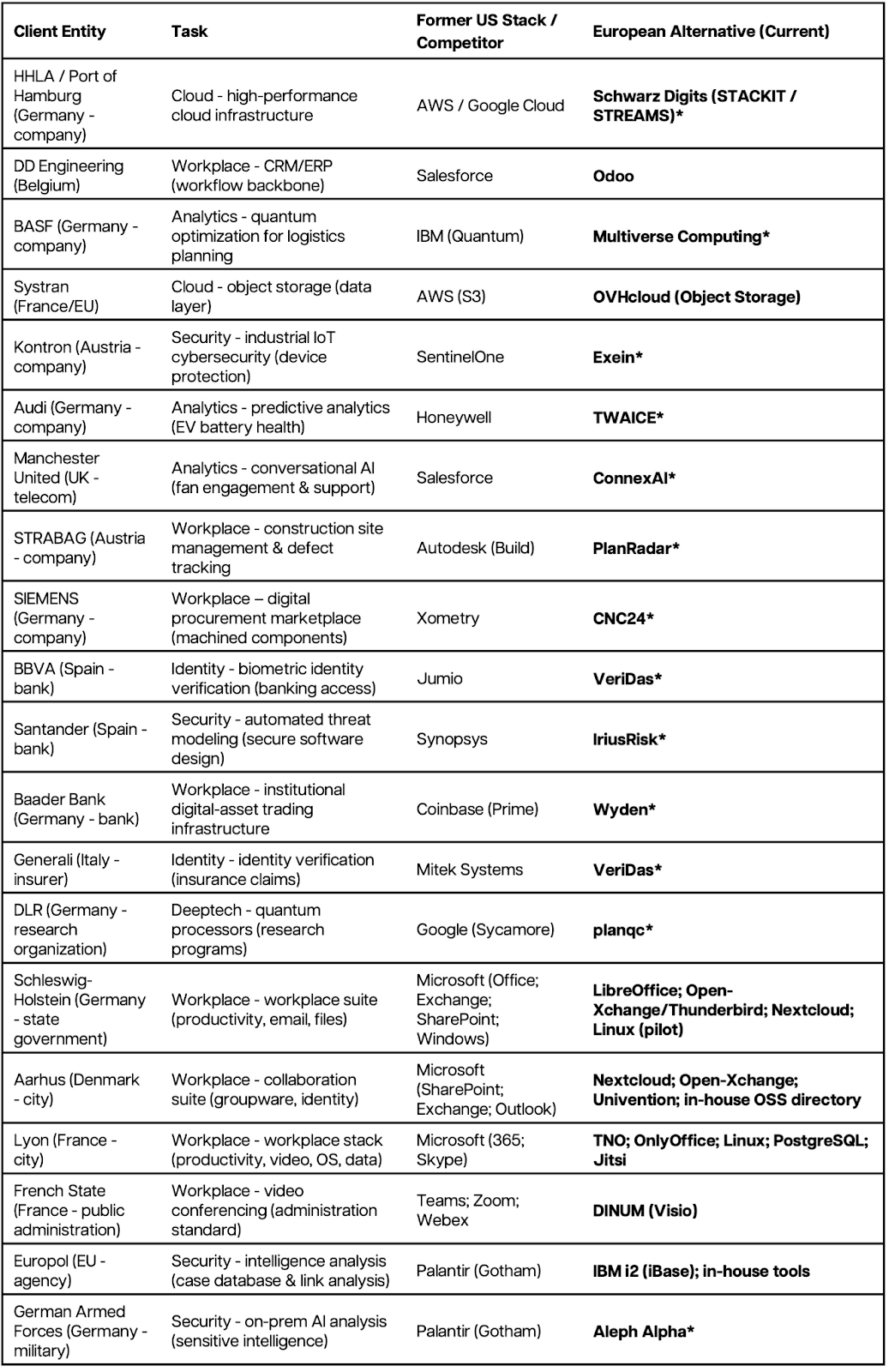
Across Europe, a structural shift is underway. Cities, countries, and enterprises are implementing a sovereign European tech stack. From Schleswig-Holstein moving away from Microsoft services, to Aarhus and Copenhagen adopting open-source collaboration platforms, to Systran and Hopsworks shifting workloads from AWS to OVHcloud, these are no longer isolated experiments. They signal a broader reorientation toward European technological sovereignty.
February 26, 2026
Redstone
3
min
Across Europe, a structural shift is underway. Cities, countries, and enterprises are implementing a sovereign European tech stack. From Schleswig-Holstein moving away from Microsoft services, to Aarhus and Copenhagen adopting open-source collaboration platforms, to Systran and Hopsworks shifting workloads from AWS to OVHcloud, these are no longer isolated experiments. They signal a broader reorientation toward European technological sovereignty.
This is not symbolism. It is a pragmatic recalibration of critical digital infrastructure.
At its core, this shift is about sovereignty and control. When critical digital infrastructure is governed outside Europe, institutions operate within external legal and geopolitical frameworks. The goal is not abrupt decoupling, but restoring leverage, optionality, and strategic autonomy.
The economic stakes are significant: with Europe’s total IT spending forecast at ~€1.09tn in 2025, even a 1% redirection toward European suppliers would shift roughly €11bn per year onto European balance sheets.
The Shift in Motion
* ASTRA investment, supporting European sovereignty and competitiveness. Astra is a consortium consisting of 360 Capital, Bullhound Capital, Redstone, Truffle Capital, UVC Partners, and 28Digital.
Economic and Ecosystem Implications
After sovereignty and dependency, cost reinforces the case. Licensing inflation and cloud pricing pressure accelerate adoption.
More importantly, redirecting public-sector and enterprise demand toward European providers strengthens the European tech ecosystem. Each move toward LibreOffice, Nextcloud, OVHcloud, Matrix-based messaging, or other European solutions contributes to scale, recurring revenue, and reinvestment capacity within Europe.
This directly supports a broader structural ambition: Europe cannot build global champions without demand at home. Sovereign procurement and enterprise adoption create that demand.
Facts
Europe’s cloud market is projected at roughly €74.4bn in 2025, yet it remains highly concentrated: AWS, Microsoft, and Google account for ~70%, while European providers hold only ~15% share. A shift from 15% to 25% would imply ~€7.4bn per year redirected within Europe (and ~€11.2bn at 30%).
An EC-commissioned Fraunhofer ISI study estimated that EU firms invested ~€1bn in open source in a 2018 baseline year, associated with €65-€95bn in economic impact and a cost-benefit ratio above 1:4. It also modeled that a 10% increase in open-source contributions could add +0.4% to +0.6% to EU GDP annually and generate 600+ additional ICT startups.
With Europe’s total IT spending forecast at ~€1.09tn in 2025, even a 1% redirection toward European suppliers would represent ~€10.9bn per year shifting onto European balance sheets.
The Core Driver: Strategic Sovereignty
In nearly all cases, the primary justification is sovereignty. Danish municipalities explicitly referenced the risks of excessive dependence on a single US vendor. French authorities framed Visio and Tchap as ways to avoid relying on “extra-European” platforms for sensitive public communications. Schleswig-Holstein presented its initiative as a move toward a “Microsoft-free workplace” to reduce structural lock-in.
The concern is not performance. It is control. When core communication systems, collaboration tools, cloud infrastructure, or document standards are governed by non-European actors, institutions operate within external legal and geopolitical frameworks. Digital infrastructure has become strategic infrastructure. Sovereignty now includes software.
Reducing Structural Dependency
Many of these transitions are designed to introduce optionality. Aarhus structured interoperability between Microsoft and open-source environments during its transition. Schleswig-Holstein is replacing components in stages (email, office suite, collaboration, then operating system) to regain leverage and reversibility.
The objective is not abrupt decoupling. It is restoring strategic flexibility. This brick-by-brick approach reflects lessons from earlier large-scale migrations: continuity and operability matter. The shift is pragmatic, incremental, and execution-focused.
Operational and Political Consequences
The consequences extend beyond procurement.
Operationally, European institutions regain control over data jurisdiction, hosting models, interoperability standards, and roadmap alignment. Politically, they reduce exposure to extraterritorial regulation and geopolitical volatility. Digital dependence is no longer merely technical. It is a matter of governance capacity.
Europe is not rejecting global technology. It is rebalancing it.
A Structural shift, Not an Anecdote
What makes this moment significant is repetition. The same motivations recur across cases: sovereignty and jurisdictional control; reduced single-vendor dependency; strategic flexibility and reversibility; strengthening European technological capacity.
The question is no longer whether European alternatives exist. They do. The question is whether Europe will choose to scale them systematically.
Samuli Sirén took the stage at TechBBQ in Copenhagen
On 26 August 2025, our Founder & Managing Partner, Samuli Sirén, took the stage at TechBBQ in Copenhagen, speaking in front of 200 curated LPs about the €7 trillion opportunity in Europe that could be unlocked if universities reached their full potential in fostering start-ups. In his keynote at the LP Forum, he emphasized that investing in venture capital is not only about capturing outsized returns from breakthrough technologies, but also about hedging against inflation and market volatility.
September 17, 2025
Redstone
1
min
On 26 August 2025, our Founder & Managing Partner, Samuli Sirén, took the stage at TechBBQ in Copenhagen, speaking in front of 200 curated LPs about the €7 trillion opportunity in Europe that could be unlocked if universities reached their full potential in fostering start-ups.
In his keynote at the LP Forum, he emphasized that investing in venture capital is not only about capturing outsized returns from breakthrough technologies, but also about hedging against inflation and market volatility.
He further illustrated how traditional real estate investors can strategically benefit from venture capital, underscoring its growing relevance in today’s shifting economic landscape.
Redstone University Startup Index 2025 – Europe’s Seven Trillion Euro Opportunity
Key Findings The 2025 study confirms wide discrepancies in the startup-generating efficiency of European universities. While some institutions create as many as 80 startups per €100 million in annual budget, others manage only one. If all 905 universities operated at the benchmark efficiency of top-performing institutions, Europe could create 327,030 additional startups in the next ten years.
July 24, 2025
Redstone
3
min
Key Findings
The 2025 study confirms wide discrepancies in the startup-generating efficiency of European universities. While some institutions create as many as 80 startups per €100 million in annual budget, others manage only one. If all 905 universities operated at the benchmark efficiency of top-performing institutions, Europe could create 327,030 additional startups in the next ten years. This could unlock:
- 13.1 million additional jobs
- €880 billion in additional tax revenue
- €5.5 trillion in added GDP
- €6.9 trillion in additional equity value
These figures are based on a rigorous benchmarking model using two separate peer groups: 93 business schools and 812 non-business universities (including general, applied sciences, medical, and research institutions).
University Index & Ranking
Unlike last year, this edition does not rank universities in a single list. Instead, institutions are organized into 8 clusters to enable fairer comparisons across different types and sizes of institutions. These include general universities (by size), business schools, universities of applied sciences, medical universities, and research institutes.
Business schools remain the most efficient, generating an average of 25 startups per €100 million in budget. Non-business institutions, regardless of size or specialization, generally range between 5 and 6 startups per €100 million, with smaller institutions slightly outperforming larger ones. Research institutes are the least efficient, averaging just one startup per €100 million.
Notably, 75% of universities included in both the 2024 and 2025 editions improved their performance, suggesting growing attention to entrepreneurship and institutional learning across Europe.
Country and City Index & Ranking
The study also evaluates regional performance. The United Kingdom leads with 9.2 startups per €100 million, followed by the EU/EEA average at 8.2, and Switzerland at 6.3. Among countries with at least 20 universities in the dataset, France stands out as the most efficient, with 16 startups per €100 million.
Among cities, Lille ranks highest in efficiency, with nearly 30 startups per €100 million of university budget. Paris has the largest combined university budget in Europe at €13.1 billion. In contrast, Bonn ranks lowest, producing fewer than one startup per €100 million.
Recommendations for Policy Makers and Universities
To unlock the full economic potential of universities, the study reinforces last year’s central recommendation: establish entrepreneurship as the third institutional pillar, alongside research and teaching.
The report emphasizes that many effective measures (already adopted by leading institutions) can be implemented with minimal financial investment. These include embedding entrepreneurship in all disciplines, activating alumni networks, fostering interdisciplinary programs, and supporting local startup ecosystems. The study also notes the importance of linking societal investment in higher education (nearly €250 billion annually) to measurable societal and economic returns.
The Study
This year’s analysis includes data from 905 universities and research institutions, covering nearly €250 billion in annual budgets and over 14,000 startups linked to alumni founders or direct university spinouts. Institutions were benchmarked against the average performance of the top 20 business schools and top 100 non-business universities to determine their relative efficiency and calculate potential gains.
With significantly expanded scope, refined clustering, and an evidence-based methodology, the 2025 edition of the Redstone University Startup Index offers the most comprehensive picture yet of how European universities can shape the continent’s future through entrepreneurship.
Redstone University Startup Index 2024 - Europe's Trillion Euro Opportunity
June 05, 2024 - Today, European venture capital firm Redstone, supported by Munich-based think tank AlpMomentum & the Brussels-based European Startup Network (ESN) release a comprehensive study titled "Redstone University Startup Index: Europe’s Trillion Euro Opportunity." This research delves into the entrepreneurial efficiency of universities across Europe, highlighting both current impacts and potential opportunities for economic growth through startup creation.
August 5, 2024
Redstone
4
min
June 05, 2024 - Today, European venture capital firm Redstone, supported by Munich-based think tank AlpMomentum & the Brussels-based European Startup Network (ESN) release a comprehensive study titled "Redstone University Startup Index: Europe’s Trillion Euro Opportunity." This research delves into the entrepreneurial efficiency of universities across Europe, highlighting both current impacts and potential opportunities for economic growth through startup creation.
Key Findings: The study reveals significant discrepancies in the effectiveness of European universities in generating economic and political value through startups. It also calculates the vast economic potential Europe could ignite. Key insights include:
Potential for Growth: By optimizing startup creation efficiency, European universities have the potential to create over 157,000 additional startups over the next 10 years. This could lead to: 6.1 million additional jobs, €400 billion in additional taxes €2.6 trillion in additional GDP = adding close to 1x the french economy to Europe, and €3.2 trillion in additional equity value.
Disparity in Efficiency: The effectiveness of universities in creating startups varies greatly, with some institutions achieving the same economic impact with €2 million that others do with €200 million.
University Index & Ranking The study ranks universities based on their efficiency in startup creation, revealing significant insights into the performance disparities across institutions. On average, the top 100 universities produce 16.6 startups per €100 million in university budget, significantly outperforming the overall average of 6.6 startups per €100 million. Business schools lead the rankings, with institutions like Germany’s WHU creating 65 startups per €100m, or non-business University Paris Dauphine, 35 startups per €100m, setting benchmarks in entrepreneurial efficiency. The rankings highlight the critical role of focused entrepreneurship education and robust support ecosystems in driving higher startup output and economic impact.
Country and City Index & Ranking The study also highlights notable regional variations, with countries like France, Spain and England leading in startup efficiency and potential economic impact. In addition to its comparatively high performance as a startup pace-setter in Europe, England also tops the list with the potential to add over 32,000 startups and 1.3 million jobs in the next decade. Among cities, Barcelona stands out as the most efficient, producing nearly 14 startups per €100 million university budget by all institutions located in Barcelona, while London boasts the highest combined university budget at €12.5 billion. These insights underscore the importance of targeted optimization and supportive ecosystems in maximizing entrepreneurial outputs at both national and city levels.
Recommendations for Policy Makers and Universities To harness the full potential, the study recommends several key actions, which the universities leading the rankings already focus on. The most important is: “Establish entrepreneurship as the third fundamental pillar alongside research and teaching at European universities.” Michael Brehm, the initiator and a co-author of the study, as well as founding partner of VC Redstone, emphasizes the critical role of universities in shaping the future economic landscape of Europe. "The magnitude of untapped potential within European universities is astonishing. However, some of the easy measures would be: Providing students with the necessary skills, presenting startups as a career option and enhancing networks. With little to no additional costs, these institutions could significantly enhance their contribution to society and the economy as well as help to transform Europe into a tech powerhouse" said Brehm.
Brehm also highlighted the importance of interdisciplinary collaboration and strong alumni networks in achieving these goals. "Connecting the right people and promoting exchange between business, technical, and scientific programs and Universities could further drive innovation and startup success," he added.
Clark Parsons, the CEO of the ESN, says the study underscores the potential of startups to help Europe close its competitiveness gap with the US and Asia. “There are several low- to no-cost measures for political leaders throughout Europe that would increase startup creation out of Universities. We hope the next European Commission and Parliament will encourage member states to do all they can to enable better startup conditions, including unlocking the full innovation potential of our university ecosystems.”
The study: The study was conducted and prepared over the last 1,5 years analysing budgets of 457 Universities and research institutions, and the startup economy in 34 European countries. From all startups founded in Europe in 2023, the study matched circa 7.500 startups to those educational & research institutions, based on entrepreneurial alumni relationships or direct university spinouts. Analysing the budgets, the team calculated efficiency of startups created, both in terms of pure numbers as well as unicorns. Taking the average of the 100 best-performing universities as a benchmark, the study was able to calculate the potential of all institutions. This established an index according to different categories, such as (non-)business schools, size of institutions or regional performances.
Germany and Europe continue to produce very successful technology companies. This is demonstrated, among other things, by the fact that the cumulative value of companies founded within the last 30 years has increased by approximately EUR 2.5 trillion since 2012. This development speaks for the attractiveness of the European startup ecosystem. Despite the positive development, German retirees hardly benefit from this dynamic.
April 27, 2023
Redstone
2
min
Germany and Europe continue to produce very successful technology companies. This is demonstrated, among other things, by the fact that the cumulative value of companies founded within the last 30 years has increased by approximately EUR 2.5 trillion since 2012. This development speaks for the attractiveness of the European startup ecosystem.
Despite the positive development, German retirees hardly benefit from this dynamic.
An extensive analysis of the ownership structure of German startups by the venture capital firm Redstone shows that German pension - and retirement funds invest significantly less in European future technologies compared to US pension - and retirement funds. German pensions and pension funds represent only a subordinate investor base for German VC funds compared to U.S. pension funds. While pension funds account for about 27% of the investor base (limited partners) in U.S. VC funds and also actively invest in German VC funds, where they account for about 15% of the capital. In contrast, German pension and retirement funds account for less than 1% of the investor base in German VC's.
Thus, German pensioners hardly benefit from the growth of new innovative companies, although both German and European venture capital firms are extremely successful in selecting emerging technology stars, so-called Unicorns. U.S. pension funds indirectly hold about 10% in German startups through investments in VC funds. Of the 47 billion euros that German startups with Unicorn valuations are still worth overall after devaluations, about 4.7 billion euros are held by U.S. pension funds. In contrast, German pension and retirement funds benefit by only about 94 million euros.
The return on investments in venture capital (VC) was not only higher than for other asset classes but also resulted in a significantly lower fluctuation margin (volatility) with similar or better returns when different assets (asset classes) were included in the portfolio, thus providing diversification. This makes VC investments particularly attractive to pension funds with a long-term focus. Case study Flix Mobility, an example of wasted investment potential, is shown by the German business world market leader Flix Mobility. German investors hold a total of about 34% of the company.
However, German retirees benefit almost not at all from this. AmericOn the other hand, American retirees significant value from the US investors involved. Planradar case study The same applies to Planradar, the global market leader for cloud-based construction software from Austria. Here, German and Austrian investors together hold 24%, but neither German nor Austrian retirees get anything out of it, as neither Austrian nor German pensions or pension funds are involved in the respective VC funds.
"There is a very large untapped potential for German and European pension and pension funds to benefit from the success of the European startup ecosystem. Increased participation of pension funds in VC funds could help German retirees to benefit from the success of the German and European startup ecosystem in the future and thus secure the prosperity of their members." - Michael Brehm, Founding Partner Redstone.

 ✕
✕